
How Caribbean Real Estate Agents Can Stay Visible During the Holiday Season
08 Oct
Please wait...
24 Jun
Caribbean Deep-Sea Discovery: New Species and Hidden Mountain Range
Most of our planet remains a mystery to humankind. Roughly 70% of the Earth's surface is covered by water, being home to the most extensive and varied ecosystems. Yet, most of it remains unexplored.
Each year, teams of scientists and marine biologists venture into the unfathomable ocean to assess the water conditions, study the effects of global warming, and research wildlife. In these voyages, they often encounter the most unbelievable specimens.
Let’s find out what scientists found off the shore of Puerto Rico and Little Cayman in the past few months.
Pressure-resistant Organisms Discovered in the Deepest Corners of the Atlantic
Venturing into the Puerto Rico trench
In the boundary zone between the Caribbean Sea and the North Atlantic, and approximately 75 to 100 miles offshore from Puerto Rico, lies a geologically unique trench. Since it was first surveyed in the 19th century, it has puzzled researchers with its peculiar gravitational phenomena and biologists with its resilient inhabitants, capable of living under a pressure of 840 atmospheres.
These are the conditions they endure at the trench’s most profound point, which is also the deepest in the Atlantic. With a depth of 8,300 meters, the trench is so deep it could submerge over 97% of K2, the world's second-highest mountain.
This sector is known as the Milwaukee Deep, and it is largely inhabited by invertebrates, which have developed incredible capabilities to live under pressure equal to thousands of elephants piled on a small coin.
Creatures found off the Coast of Puerto Rico.
In March, expeditions ventured into the trench to find the deepest living fish ever captured. Known to scientists as Abyssobrotula galatheae, or cusk eel, this fish survives intense pressure.
Down where most living organisms would have proteins on their bodies destabilized, the cusk eel thrives because it accumulates a protective chemical in its tissues.
Another surprising finding was Scopelocheirus schellenbergi, an amphipod that had so far only been found in the deepest regions of the Pacific, such as the Kermadec Trench.
To the eye, they appear like weird-looking shrimp, and they are extremely voracious scavengers: they feed on organic matter and waste, and are capable of devouring an entire fish.
Underwater Mountains Around the British Caribbean
Also in March, the UK Center for Environment, Fisheries and Aquaculture Science led an expedition across several Caribbean islands and made a significant breakthrough. Near the coast of Little Cayman lies a geological treasure that had remained hidden from human eyes until this March.
The range starts at a depth of 2,500 meters and extends to 20 meters below the surface. The expedition also found a giant blue hole plunging to the depths of the Earth, reaching 550 meters below sea level.
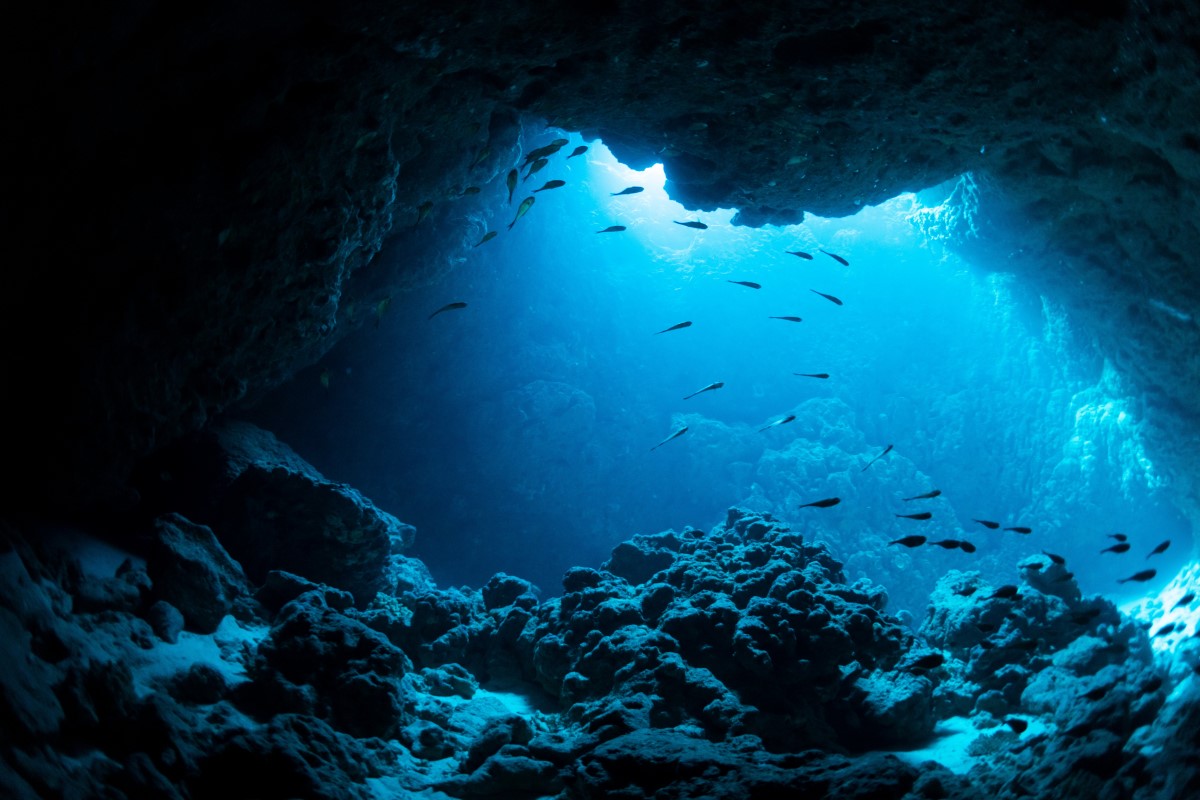
The most surprising fact was to find the slopes thriving with subaquatic life, since these formations are usually barren. They are covered with exceptionally healthy gorgonian coral, growing free from the disease that has been affecting the reefs across the Caribbean. Protected by its great depth and sheltered by the mountains, it’s home to a vast population of jelly-like orange sea sponges and is visited by large schools of fish.
The six-week expedition explored these subaquatic landscapes using cameras and sonar probes operating at a depth of 6,000 meters.
Among the amazing wildlife they found, there are glowing dragonfish, a barreleye fish with tubular eyes pointing upwards, and a pelican eel with a dashing pink tail. The scientists acknowledged that some of these rare specimens are still unidentified.
Thanks to the inventiveness and hard work of these teams, humanity is slowly breaking through one of the world's most mysterious and hardest-to-reach ecosystems. Unfriendly conditions, such as extreme temperatures and intolerable pressure, make diving and equipment deployment challenging.
On the other hand, the inhabitants are, by nature, fragile and can't be captured or studied using traditional tools.
Whether in the depths of the Puerto Rico trench or the long-stretching range near the Cayman Islands, there are still vast recondite regions to be explored and many things to learn. The secrets of the ocean still lie quietly down below, waiting to be uncovered by our relentless curiosity.